
Get to know this plant.
Identification clue 1
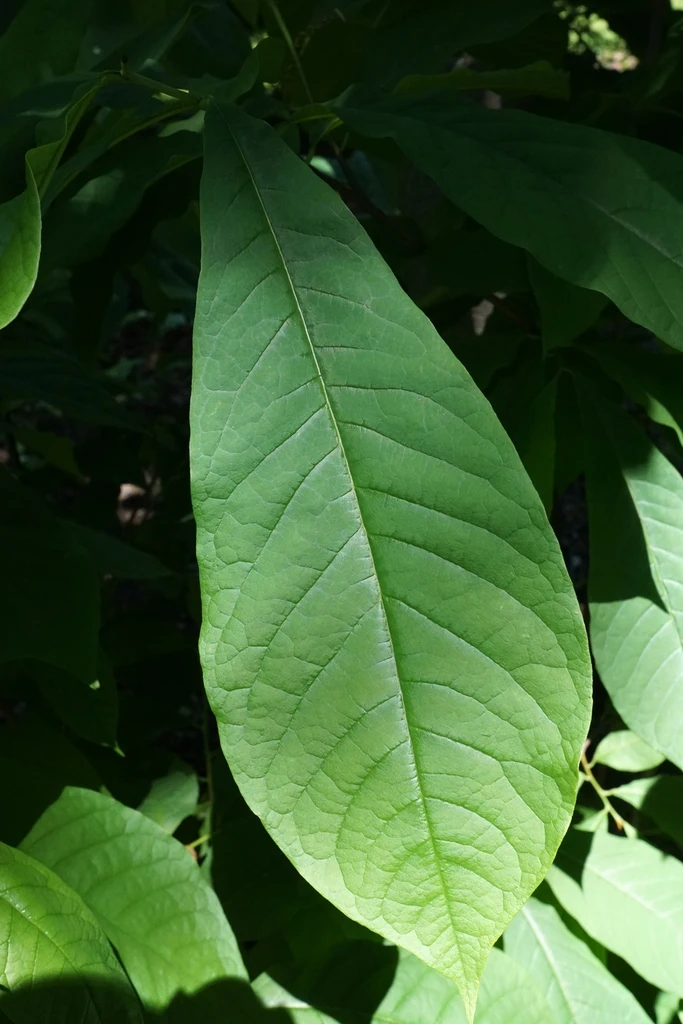
Large leaves broadest above the middle
Identification clue 2
Leaves often cluster toward twig tips
Identification clue 3
Large green fruits in small clusters
Read the leaves
Smooth-edged blades taper toward the stalk and often droop. Confirm alternate attachment beneath the apparent cluster.
More growing details
Read the bark
Gray bark is fairly smooth, becoming lightly textured with age.
Fruit & seed
Large oblong fleshy fruits can occur in clusters; fruit may be absent on isolated trees.
Winter character
Naked fuzzy buds and a slender understory habit provide winter clues.
Origin & place
The species occurs naturally in the southern Appalachian region; a planted specimen is not evidence of wild local origin.
Compare with Cucumbertree magnolia
Cucumbertree has cone-like aggregate fruits and more furrowed old bark; pawpaw bears large fleshy fruits.
WNC Notes
Native edible understory tree; use two genetically different plants for fruit and protect young foliage from full sun.
Sun Exposure
Full sun–part shade
MATURE HEIGHT (FT)
15–25
MATURE WIDTH (FT)
10–15
BLOOM SEASON
Early spring
BLOOM COLOR
Maroon
FALL / WINTER COLOR
Yellow
Wet-Soil Tolerance
High
Drought Tolerance
Low